Spending an evening out on the town with my dear wife, I
decided to crowd-source our evening's activities . . . of those that responded, one D.C. suggested that I check out a lecture on
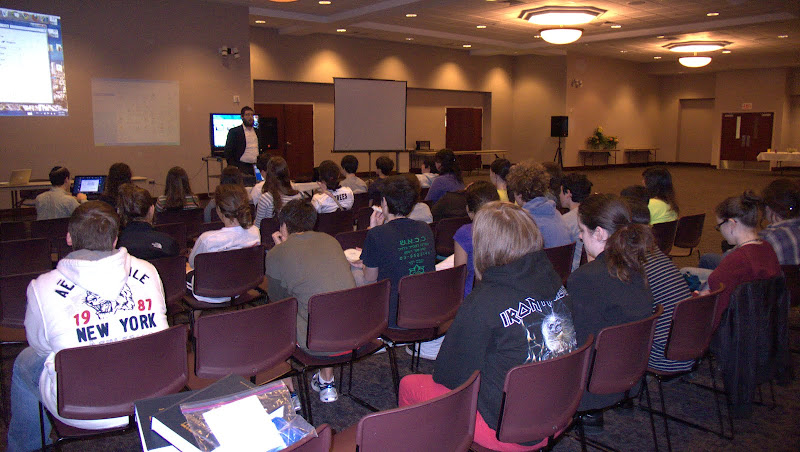
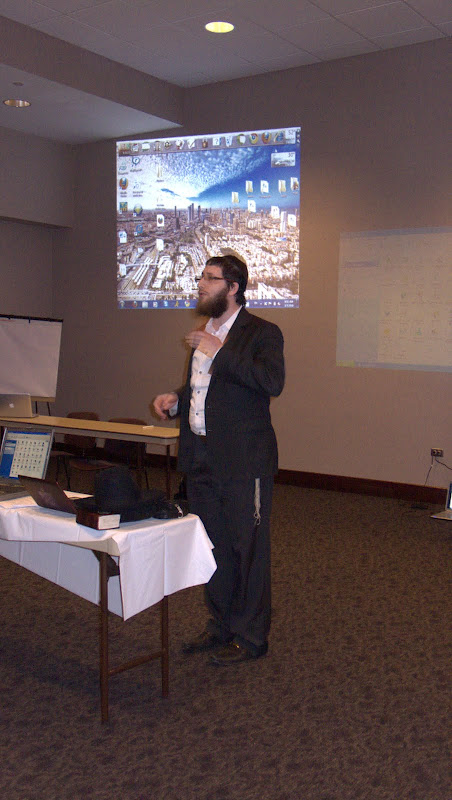
Freud’s Jewish Identity presented by Dr. Arnold D. Richards with Prof. Susannah Heschel at the New York Psychoanalytic Institute.
After dinner, we did indeed go.
What follows is a collection of my thoughts and notes from the evening. I make no attempt to represent the complete opinions of those that spoke. I've made no attempt to check if my words hold water among academics, nor do I care to impress them . . . Rather what follows is a synthesis of ideas as they have occurred to me.
Richards (see his paper for a full discussion of the subject) seems to explore the essential dichotomy and/or duality of Freud's Jewish identity - as exemplified through Bildung, Antisemitism and (something that was mostly skipped due to lack of time) his atheism.
 Freud, the child of Galician immigrants ("Psychoanalysis is a Galicianer science.") expressed an almost contradictory sense of pride in his Jewish roots and a shame of his Jewish, and especially Eastern European (Ostjuden), brethren. In an attempt to synthesize these two conflicting opinions, Freud re-imagined his lineage to that of Jews from Cologne (who, brought to the city by the Romans, preceded the Germanic tribes in the area), via Lithuania to Vienna.
He denied his ability to speak or read Hebrew and Yiddish, yet visited his mother, who primarily spoke Yiddish, every Sunday. He had a volume of the Talmud [I'm not sure which mesechta] with a German translation, as a gift from his father. Never truly at home as an Austrian or a Jew . . .
His work, Moses and Monotheism is in effect, a summation of Freud's own Jewish dilemma - he sets Moses, the father of all prophets - the quintessential Jew - as an Egyptian . . . Yet Moses in-turn gives rise to the forced veneer of Jewish morality via christianity - forced upon the essentially pagan Teutonic tribes.
Martin S. Bergmann spoke of the change that had occurred in the field of psychoanalysis in terms of its Jewish roots - in the past had anyone called Psychoanalysis a Jewish science, it would have been rooted in antisemitism. Freud's decision to anoint Carl Jung, the handsome non-Jew, as the heir to the throne of psychoanalysis was an attempt to remove the field from its Jewish roots - to make it more palpable to the German public. Perhaps, Bergmann theorized, psychoanalysis's Jewish roots stemmed from the attempt of its founders, who sought to understand the world through logic and science, to relate to the irrational and illogical hate of Antisemitism.
Another speaker thought to apply Bergmann's view of psychoanalysis as a logical attempt to comprehend the illogical hate - as perhaps a desire to remove themselves from the illogical nature of religion and instead view the human story by means of science . . . and there I see the ultimate failure of the cyclical nature of the discussion.
Susannah Heschel indeed noted the failure of the argument that psychoanalysis is an attempt to provide a logical framework that can replace the illogical nature of religion - for if so, then psychoanalysis has become the new dogma that we subjectively view man with - at which point it can no longer effectively replace the illogical G-d, for it itself has become illogical. 
Heschel stems from Chassidic roots - and her stance seems to make it eminently clear. Psychoanalysis isn't the result of the chesbon hanefesh, as one suggested, or at least not the accounting of the soul as seen in light of the Mussar movement, but rather akin to the Chassidic Rebbes - who invested themselves into those who approached them. She seems to understand the third power that transcends both the logical and illogical.
Freud saw circumcision as an Egyptian act. Religion is fear, and circumcision is a symbolic substitute for castration. But Heschel sees the circumcision through its Jewish context - as a covenant - a physical reminder of our receiving the Torah from G-d. By the circumcision the Mohel performs
metzitzah b'peh - akin to the kisses of the divine (Let him kiss me with the kisses of his mouth: for thy love is better than wine -
Shir Hashirim), or the suckling of the child on the breast. It is not castration by G-d's anger, but rather his kiss of love.
As mentioned by D.C. during the question period (mirroring my own thoughts), the Bris in Chassidic terms, takes place on the eighth day, because it transcends the realm of time and nature - the seven days of the week. The child, who can not think and reason, who can make no decision about the meaning of the circumcision, is able to connect to the transcendent quality of the creator.
The early psychoanalysts failed to understand religion because they were trapped within the realm of logic. In an attempt to understand the world through the lens of logic, G-d may not fit into the frame. As mentioned by one of the questioners, Judaism has a long history of analyzing the Torah with the mind - yet in the eye of 'scientist' it remains inherently illogical since the ultimate source of the discussion, G-d, is sacrosanct.
However in the tradition of Chassidus Chabad, there is no contradiction between the rational study of an 'irrational' Creator - for the rational and irrational are part of the mortal coil. Just as there is a failure to understand Freud as a product of his background, if we are limited to describe him only with the vocabulary of his own subjective thought, if we try to find the relative merits of critical logic and religion, we remain trapped in cyclical discussion.

The Creator is not irrational, but rather suprarational. By trying to understand the Torah, a transcendent knowledge, then we allow our physical minds to bridge the gap of logic and what is beyond logic.
Though not overtly expressed by anyone - I found it ironic that some seemed to analyze Freud himself and his Jewish identity - in the light and context of psychoanalysis. It seems to expose the essentially cyclical and self-referential nature of psychoanalysis. We wish to analyze Freud's theories through the lens of Freud the man - yet we use the vocabulary of his thoughts to understand the background and society that created the man . . .
A prisoner can not set himself free.
In an institution that worships on the alter of German and Austrian fields of thought, Richard's clearly Ostjude personality and vocabulary provide an almost ironic sense of the ultimate victory of the Eastern European, Chassidic, Jew.
In the past the NYPI would meet on Yom Kippur - in their attempt to flee to constraints of Jewish ritual and the shtetle, its members had in effect remained very much bound by their Jewish roots. Yet today, looking and listening to the crowd, I found only the faintest trace of German, even Judeo-German, culture . . .
Unlike Freud, who tried to hide, unsuccessfully, his Yiddish vocabulary and roots - these Jews were very much party of the cloth of the "Galician" story and scene.
I wonder what Freud would have said.
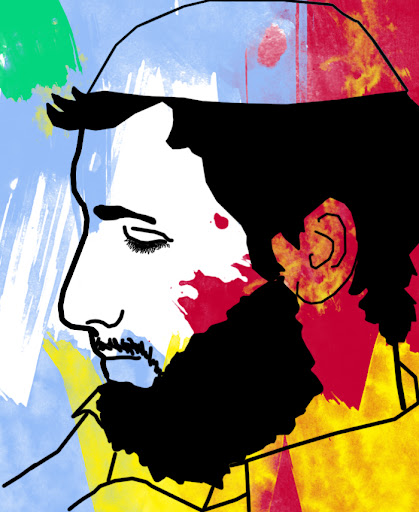
(Escher Image Credit - Archival Images from Life Photo Archive)
Edited May 13, 4:10 pm for clarification and proper image attribution
Technorati Tags:
Psychoanalysis,
Judaism,
Freud,
Thoughts,
Essays,
Life,
Social Media,
Crowd Sourcing