The letters of our thoughts are the ideas present in our mind before they come to realization . . . Thoughts that are, yet not felt . . . The words of the subconscious . . . of the soul . . .

These are the LETTERS OF MY THOUGHTS.

Sunday, January 30, 2011

Mottel Cooks: Pan Cooked Salmon on Goat Cheese Salad

    The picture doesn't do justice - sorry!

Salad:

  • Mesclun
  • Romain Lettuce
  • Cherry Tomatoes
  • Red Onion
  • French Herb Chevre
  • Toasted Almonds
  • Grated Parmesan cheese
  • Dressing
    • Dijon Mustard
    • Honey
    • Balsamic Vinegar 
    • Olive Oil
    • Lemon Juice
    • Salt
    • Pepper
    • Oregano
  • Salmon

Coat salmon with with olive oil, then cover with crushed pepper, paprika and a kosher salt. Cook in pan until salmon is flaky. Add fresh rosemary at the end of cooking.  

Almonds should be coated with a olive oil, salt and a small amount of organic sugar. Cook at 350 degrees until well toasted.

Served with Sourdough bread and Tomato-Basil soup. Paired amazingly with the delicious Weihenstephaner Hefeweissbier Dunkel.

Read More...

Wednesday, January 26, 2011

Op-Ed: The Key to Peace in the Crown Heights

A week has gone by since an “Installation Ceremony” crowned Rabbi Yosef Braun as the third member of the Crown Height’s Beis Din. The event, the culmination of months of backroom deals, private negotiations and heated public debate, should have brought an end to the discord and fighting that has plagued our community. Yet all was not as it seemed. Rabbi Osdoba, the senior member of the Beis Din, made a simple request - that Rabbi Braun show the two smichas mentioned in the psak. His request unfulfilled, Rabbi Osdoba was absent from the installation. 

What happened, and what does all of this mean to us? 

At the time I watched the proceedings, as they were streamed live over the Internet, from my home. I debated the proceedings online with my friends. Over a week has gone by since the installation, and my feelings and ill-ease with the situation have not subsided. If anything, the issues that trouble me have grown. Upon seeing the latest revelation, the misinformation fed to Rabbi Amram Klein - as revealed in a recent letter revealed to the public - I feel that we can remain silent no longer. 

Before continuing, by means of full disclosure, I’ll be upfront and say that I did not vote for Rabbi Braun. I was bothered by his lack of experience, unimpressed by his campaign that focused more on his prowess as a mashpia, as a youthful figure with the ability to reconnect with the estranged younger generations, than on his knowledge of psak. What is more, I found the campaign around him to be dirty and dishonest. I was bothered that he was being propelled forward by mudslinging, yet when asked about his campaign, he pleaded ignorance of any organized effort on his behalf. Kolel Yungeleit were tricked into signing what was supposed to be a private letter to the two existing rabbonim, that was then falsely circulated as an endorsement for Rabbi Braun. I was not impressed.

That all being said, I’m a firm believer in the democratic process.The transition of power to the winning party, even if not of one’s chosen candidate, is one of the most powerful aspects of the democracy. As such, as we entered the new year, I was ready to accept Rabbi Braun as the third Rov. 

Unfortunately, the lack of transparency - if not the utter turbidity - that plagued Rabbi Braun’s campaign came rearing to an ugly front. Rabbi Braun’s very qualifications as a rov were called into question. All that was needed was for Rabbi Braun to furnish the necessary documents, show the world that he did indeed posses the necessary smicha, and it would have ended there. Instead the issue lingered. When a psak was finally issued by the Zablo Beis Din, it did not posses the signatures of the five rabbis involved. Documents - including the very smicha that was claimed to be universally legitimate and acceptable to all - were not made public. Rabbi Yoel Kahn, the Rebbe’s chozer, and Reb Pinye Korf signed with others on an open letter to Rabbi Rosenberg asking that he provide the transparency that we, the residents of Crown Heights, deserve. 

As such, though the possibility to nominally install Rabbi Braun as rov in Crown Heights existed, clearly something was rotten in the state of Kan Tziva. 

Here is where everything breaks down for me:

Watching the ceremony that Sunday night, I was shocked by the cognitive dissonance of the events organizers. The speeches focused again and again on achdus, on the unity that was so long needed in Crown Heights finally coming. Yet looking at those seated at the head table and speaking from the dais, all I saw were the same tired faces that took part in the machlokes that initially tore our community apart. Were it not for the yeshivah bochurim schlepped in to inflate the crowd’s size and the Hungarian Rabbonim brought in as friends of the Braun family (some victims of the fore mentioned subterfuge), those gathered would have been incredibly monolithic. I mean no respect to those who gathered, but their cries of unity were cynical and hollow. 

If the night of 12 Shevat were truly one of unity, then where were so many of the rabbonim of our community? Where was Rabbi Heller? What about Rabbi Garelik? Where were Rabbis Yisroel Friedman or Gerlitzky? What about the mashpiim? Where was Reb Yoel Kahn? Reb Sholom Charitonow or Pinye Korf? Was Rabbi Yossi Jacobson there? Where were Rabbis Gronner or Simpson? What about Rabbi Shmuel Butman and other members of Tzach? 

Unity would be when two opposing forces are brought together, by a third higher power, negatinf the source, or at least the expression, of the conflict. What we witnessed that Sunday night was not unity, but rather a self-congratulatory and strictly partisan affair. It’s insulting to the intelligence of the inquisitive observer when the self-adulation and empty speeches that were preached to the choir were passed off as unity. 

Again and again friends have told me that it’s time to give Rabbi Braun a chance. That this was our last great chance at peace, and that my questions were only serving to continue the fight. 

Truth be told, this has nothing to do with Rabbi Braun the man - at least not to me. I’m sure he is a well-meaning and learned individual. My issue is with the lack of transparency and deceit that makes the very legitimacy and possibility of giving Rabbi Braun the chance he deserves! The simple act of full disclosure and honest conversation will bring an end to this debacle. Until that time, however, we remain hostage to the machinations of the rabble-rousers that wish to break the very foundations of the community they claim to aid. 

Ponder this: although Zaki showed a spirit of compromise - agreeing to continue with the installation, while delaying the actual signing of Rabbi Braun’s contract leaving time for the smichas to be produced. The other members of the Va’ad, however, went behind the collective backs of Rabbi Osdoba, Zaki and the entire community, signing the contract with Rabbi Braun. Why Rabbi Braun was unable to wait a few weeks, so that the signing of his contract be accepted by all parties involved, is beyond me. 

Information wants to be free. It is the basis of the modern era of free exchange and thoughts in which we live. It is the foundation of democracy and the bane of communism and fascism. What is more yemos hamoshiach are the very epitome of transparency and honesty - a time when knowledge will fill the entire world. 

Therefore we must ask Rabbi Braun: 

Please end partisan fighting and politics once and for all. Rabbi Braun - to help bring the peace and unity that I’m sure you also want - as a first step, please release the documents in connection with this case.


(reblogged from CrownHeights.info)

Read More...

Tuesday, January 25, 2011

Weird Sign Wednesday XXX (As in 30)


You mean I get WiFi and Internet? Amazing!

Read More...

Child on a Möbius strip

Changing my sons diaper one day I had an epiphany. There, during the deepest moments of fatherly duty, the deed that only a parent could do for his child, I experienced a fleeting moment of clarity.

My son, being stripped of his clothes, screamed to all around him. His tiny hands batted the towel under him. His legs took dangerous swipes in the air - missing my nose by mere inches. Tears, large and salty, welled up in his eyes.

And I laughed.

I laughed because at that moment I understood that I had been no different than him. I had been an infant, screaming inconsolably as I was changed on a table. My father had been changed by his . . . and so the train went back.

And what was more, when I am old and hoary, my son's son will do the same to his own, son.

Picking the baby up - the emobdiment of that eternal child that always was and always will be, kicking and screaming - fighting the demons that even he does not see . . . I kissed him and he smiled.

(Image Source: Life Archive)

Read More...

Wednesday, January 19, 2011

Paul Cézanne: Still Life, Drapery, Pitcher, and Fruit Bowl

(Image Source)


Read More...

Tuesday, January 18, 2011

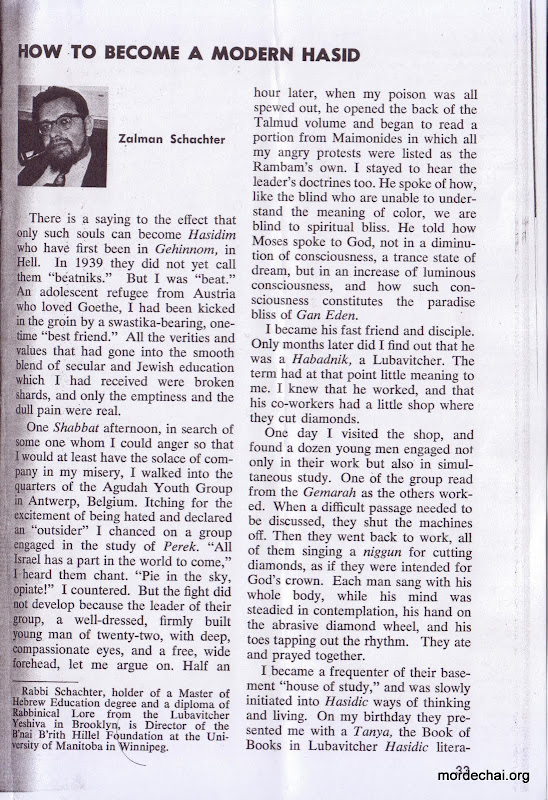
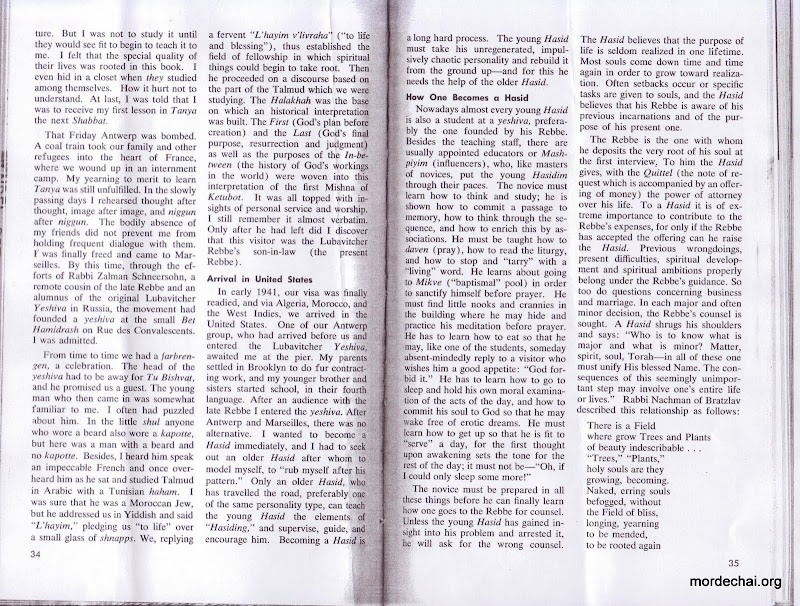
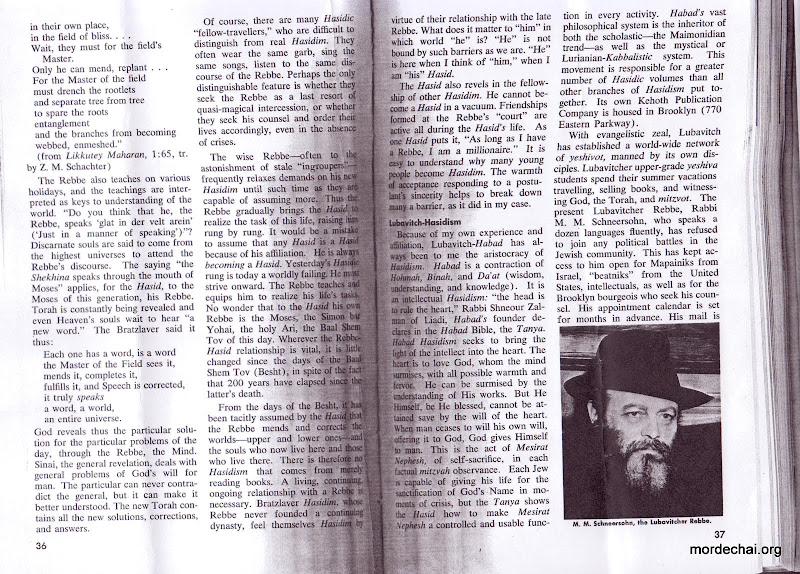
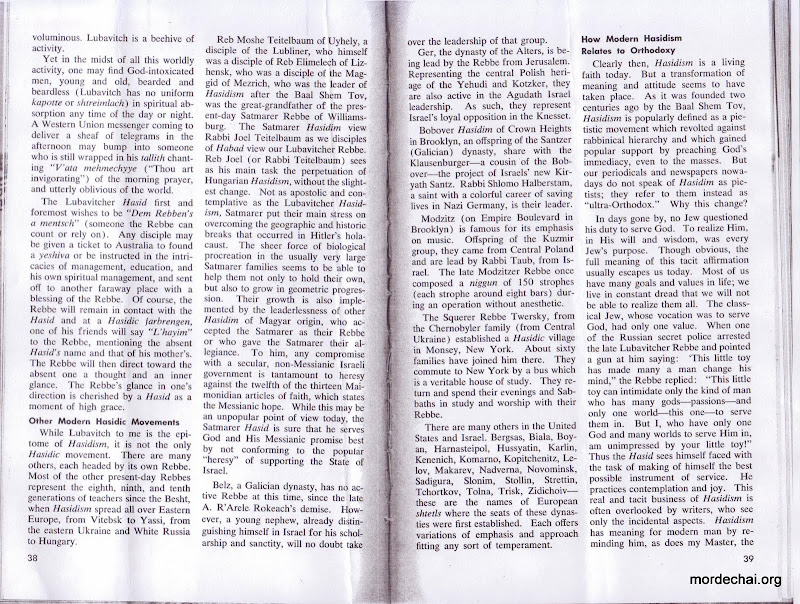
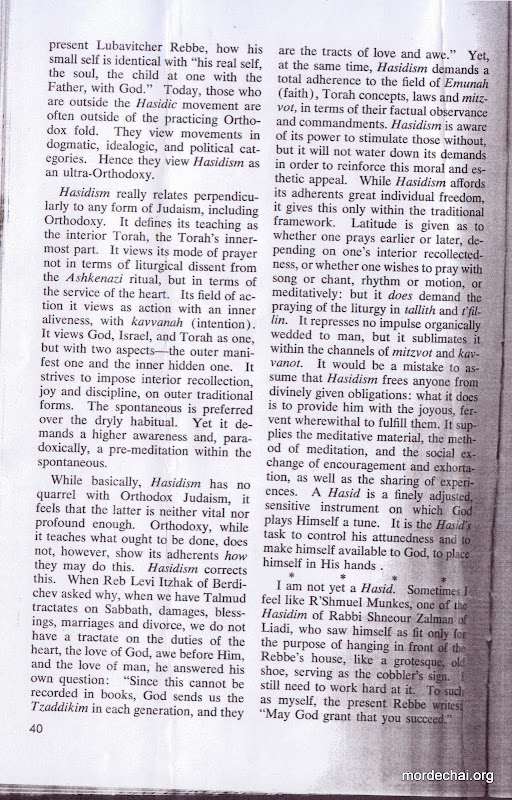
Zalman Schachter-Shalomi On How To Become A Modern Hasid

Image source: Reb Zalman Legacy Project
  A few weeks back on the now defunct Asimov Rants blog, the discussion of Zalman Schacter came up. At the time Zalman Alpert mentioned an article, penned by Schachter, about what it means to be a "Modern Hasid."
 Zalman (Alpert that is) was kind enough to send me a copy of the article. I'm posting it here for the edification and enjoyment of the readership of this blog.
 I must admit that due to my schedule I've been somewhat delinquent in putting the article up, but I'm sure the article was worth the wait. On a side note: I'm interested in posting further articles and documents of Chabad and Crown Heights historical interest or note. If you have anything of interest please email me: mordechai7215 [at] gmail [dot] com

Click on the link to read and enjoy!


Read More...

Monday, January 17, 2011

A thought

My father was in Crown Heights this past week.
He asked me if the creaking of the ceiling fan bothered me.
Now I'm stuck wondering if it has been creaking since I moved in, and I just learned to ignore it, or if it only started that morning

Read More...

Investigating 'Ahavas Yisroel Shul'

Dear Yael,

In your recent op-ed on the new Chevra Ahavas Yisroel synagogue, you ended with a request for "enlightenment." While I do not claim to be the sole proprietor of truth nor the arbiter of what is and isn't Chabad - I would like to discuss the matter, and hopefully, G-d willing, a clearer understanding of the situation may be reached by all.

Allow me to preface: This is not meant as a critique of your character - nor of anyone else mentioned in your op-ed. Rather it is an analysis of certain concepts and changes in the ethos of the Crown Heights community.

First of all, it is wonderful that you have found a shul in which you feel welcomed and comfortable. Yes, Lubavitch does indeed mean "city of love," and the Rebbe instilled a deep ahavas yisroel within Chabad Chassidim, many of whom have traveled great distances to establish Chabad Houses to warmly welcome all Jews.

Yet you continue to write that "This is a democratic country, and God is not owned by the zealots." You say that the "ultra Chassidic would not feel at home there, but that no one is forcing anyone to go." At this point, I would like to respectfully disagree with this premise - on which much of your article is based.

Judaism does not exist in a vacuum. Just as one cannot claim to understand the divine will of the Creator as written in the Five Books of Moses without the oral tradition that has been handed down from Moses on Sinai, so too our understanding of the application of Jewish law, the rhythm of Jewish life, custom and chasidic nuance are all part of a long tradition.

To view Judaism as sola scriptura - by merit of one's own interpretation - is to leave it devoid of its true meaning.

In the context of Chabad, this means that our understanding of what Chabad is - and isn't - is based on the words of the Rebbeim as understood and passed down from generation to generation of Chassidim. What is more, there is a certain aspect of Chassidic culture that cannot be given over in words. This - the Arum Fun Chassidus - the milieu of chassidic life - is key to understanding what is and isn't appropriate for a Lubavitcher Chossid.

As such, certain actions, like the choice of which songs we use in the shabbos liturgy, the ways in which we seek spiritual enlightenment, and the overall standards of our community, must all be viewed in the context of the over 200 years of Chabad. [As a parenthetical note - the assertion that "Chabad born composer[sic]" Shlomo Carlebach's music should be acceptable due to his supposed heritage is both historically inaccurate and specious.

Carlebach was never Chabad born - rather he was scion to a prominent German rabbinical dynasty. After coming to America and a stint in Lakewood he came to Lubavitch. Within a decade however, he moved on. In his words, later printed in Tikkun magazine Sept. 1997, he related that "the Rebbe said to me, "I cannot tell you to do it your way. But I can't tell you not to do it your way. So if you want to do it on your own, God be with you." So I split."

In any event, even if Carlebach had been a born Lubavitcher, his background would be meaningless - Solomon Schechter, a renowned scholar and theologian, whose theory of Catholic Israel has been the driving force of Conservative Judaism for over a century was indeed a "Chabad born" Jew - his Hebrew name was Schneur Zalman.]

If one truly wishes to understand Chabad, what it is and what it teaches, then it is not only important, but necessary to turn to Rabbonim, Mashpiem, and Roshei Yeshivah.

On Motzei-Shabbos Parshas Terumah, 2 Adar 5748, the Rebbe delivered a sicha that can called nothing short of his ethical will. Central the ideas discussed there was the need to listen to a Beis Din of Lubavitcher Rabbis [keep in mind here that the Rabbis discussed here are true rabbonim - not mere pulpit rabbis.]

Thus the individuals mentioned in your op-ed (please, however, see below) understand quite well when the love in Lubavitch is appropriate, and when it is not. They are aware of the Rebbe's dictum of bringing every Jew closer to his heritage with bonds of love.

They are also, however, aware that we are to bring others closer to the Torah - not the Torah closer to them. We love every Jew. We do not, however, love every Jew's shtick. If something is truly foreign and inappropriate to Chabad, then no matter how effective a tool it may be in spreading Yiddishkeit, it is a betrayal to everything the Rebbe, Chabad and Chassidus stand for.

Today, for better or for worse, we are pulled by the dialectical tensions of the dual culture in which we live. We must walk a fine line if we wish to stay true to Torah and chassidus whilst enjoying the benefits of a 'modern' life.

With that said, there are certain beliefs and ideas that are completely foreign to Judaism. In America, there has been a deterioration of the idea of the community and trust in authority since the middle of the previous century. The axiom that 'it's a free country,' besides very likely being at most a vast over simplification and ignorance of what first amendment rights truly represent, is most definitely an anathema to traditional Judaism.

If a shul were to enact certain things that are truly damaging to the standards of the community as a whole, then as part of the community there is an obligation to address their actions.

This is in regards to the general question of change and tradition within Chabad.

* * *

Pertaining to the so-called Ahavas Yisrael Affair, it would seem that your well intentioned effort to defend your new-found shul of choice may in fact have brought about the opposite result.

In order to better understand the situation, I was asked by COLlive.com to spend some time with R' Chezzi Denebeimdiscussing the various claims.

Of the rumours recounted in your op-ed, you claimed senior rabbis demanded that Chezzi extend the mechitzah. Chezzi explained to me that on their first Shabbos, they were expecting around 30 people. They set up 15 chairs for men and 15 for women with a sufficient mechitzah in between. However, when upwards of 80 people filed into CAY- the facility was simply not prepared - leaving the the mechitzah's length insufficient. When preparing for the following week, Chezzi extended the mechitzah on his own accord.

While I don't think you recounted these spurious claims against CAY with any ill intent, I do highlight them to point out the dangers on publicizing rumors and unsubstantiated information.

Among the other issues:

1. It would seem that a number of the rabbis mentioned did not in fact speak to R' Chezzi Denebeim.

2. After hearing that certain important individuals within the community did wish to speak to him, Chezzi Denebeim willingly approached said parties. Any questions as to purpose and conduct of the shul were addressed.

3. There has never been any issue with mixed seating. Shiurim are not mixed. Shabbos meals were initially separate, but without a mechitza. Based on suggestions from others, they are now done with a mechitza. [In regards to your question about mixed shiurim, I might add that while there were certain instances where the Rebbe allowed mixed Torah classes - they were based on the specific conditions and needs of the community - and not a general rule of conduct.]

4. The Mimulo flowershop does not have any connection to CAY other than renting them the space for Shabbos.

As Lubavitchers we ought to be aware of the priceless traditions we posses. The deep insight of Chassidus, the geshmak of a nigun, the power of hours of davening - these things are our legacy to the world and our source of pride.

While I am by no means endorsing the shul - I have neither the authority nor an intimate knowledge of the shul to do so - I do not see this shul as coming to replace any of those things we hold sacred.

Sadly there is a segment of the population that is alienated from these traditions. The fact that a niggun or vart from Shlomo Carlebach, Breslov or Karlin attracts people over niggun ha'aruch of Reb Hillel Partischer or a Ma'amor in Somech Vov is more a testament of our own failings as a community. If people, born within, and currently associated with, the Chabad tradition do not treasure what the rebbeim have given us - then we must find a way to make it meaningful and relevant to their lives.

I see this shul as a grounds-up attempt to enfranchise a segment of the population no longer enamoured and perhaps alienated from the community as whole. This is an attempt to end the apathy and indifference that is eating at the heart of our community.

If someone has a better way of addressing the issue, then by all means it should be done. In the mean time, however, it would be cynical to attack the shul without providing a viable substitution.

As long as those in charge of the shul continue to consult with rabbonim, listen to the honest feedback of concerned members of the community, and direct their members in the right direction - it ought to remain a viable entity in Crown Heights.

I welcome all feedback on the situation from both you as well as others. Yael, if you in any way wish to discuss things further, please contact the editors of the site for my info - my wife and I would gladly extend a shabbos invitation to talk further on the matter.

Read More...

Sunday, January 16, 2011

On Volozhyn, Novardok and Chasidus

This Shabbos I stopped by the aufruf of a friend.

His grandfather - Reb Mendel Morosow - mentioned an interesting story.

While standing in the slaughterhouse for Swift's kosher meat line.

Standing next to him was a Novardoker and Rabbi Joseph B. Soloveitchik - the Rav.

The Novardoker talmid asked the Rav why in the Volozhyn of old they didn't learn Musar. The Rav turned to him and asked,
"I have a greater question - why didn't they learn chasidus?"


                                       Reb Mendel Morosow

Read More...

Saturday, January 15, 2011

For Your Enjoyment: Two on Yud Shevat

Get this widget | Track details | eSnips Social DNA
Newly remastered by the good folks at JEM


Please check out my article - Transition in Lubavitch: January 28, 1950

Read More...